

You’ve owned some bitcoin for a while and finally want to spend some, but there are basically no stores around you that actually accept bitcoin. You could just sell some bitcoin for dollars, then transfer those dollars to your bank account, and use your normal debit card. You could just use a credit card, then sell some bitcoin to pay off the card. Or you could sign up for one of the newest bitcoin debit cards and spend directly from your bitcoin exchange account.
A bitcoin debit card doesn’t actually let you spend bitcoin at a merchant that doesn’t accept bitcoin. It’s basically a card that allows you to sell bitcoin for dollars on the fly, then pay the merchant in dollars. The mechanics of how this trade happens varies for each card issuer, but at the basics, that’s what’s going on.
A bitcoin debit card is not a card that’s linked directly to the bitcoin network. There are bitcoin cards being developed that would allow you to spend bitcoin via the lighting, but they will require that the merchant accept lightning bitcoin payments. Coming soon™.
For now, a bitcoin debit card is going to mean that you have a bitcoin exchange account somewhere with a bitcoin balance, and then your physical card will allow you to sell bitcoin into dollars, then spend those dollars at the merchant.
Physical & Virtual Bitcoin Debit Cards
Each company has a slightly different setup that allows you to spend your bitcoin via debit card, so read up on the details of how each works to find one that fits your expectation and lifestyle the most.
CoinDebit
CoinDebit is a bitcoin-only company, and you can choose a virtual or a physical card.
This means you can use your bitcoin anywhere that accepts debit or credit cards. They say that the card can be loaded in 10 minutes, so I’m guessing you don’t have to wait for six confirmations to use the cash. You interact with your card via an app and can load bitcoin onto your card from any bitcoin wallet. That’s nice because you can just keep a small stack in your hot wallet, then spend bitcoin directly or via card depending on your situation.
There are two main downsides. One is that there’s a $250 max limit at the moment, so no big purchases with CoinDebit right now. The other is that you cannot top up your balance on the fly. The card had to be pre-loaded at this time. It’s still in beta, so that may change in the future.
With those spending limits and the fact that you can’t “top up” at the moment, I’m not 100% clear on what “loaded in 10 minutes” means, though perhaps they are just talking about the virtual card.
Related Content






Bolt Card
The Bolt Card is a physical bitcoin debit card from Coin Corner that uses NFC so you don’t even have to swipe your card or insert a chip. The Bolt Card actually uses lightning instead of on-chain bitcoin to facilitate the payment and doesn’t require you to convert the balance to fiat first. It’s super easy to spend bitcoin directly from your Coin Corner account like you would with a bank card!
The main downside is that Coin Corner is a UK company and is operating mostly just in Europe. Their card, as-is, requires a Coin Corner account, so many of you reading this won’t be eligible for the card.
They’ve mentioned on Twitter that a non-custodial option is on the way, but have also said that these cards can already work with non-custodial wallets, so I’m not sure what the status of that is. It’s a bit unclear if, and how, a non-custodial option would work. Would a merchant be able to accept transactions from lightning and receive fiat? Would it still require CoinCorner to facilitate the payment in some way? Would it only work with merchants who accept lightning? It’s unclear at the moment.
Cash App
Cash App is one of, if not the most popular finance app in the US, and they support bitcoin buying, selling, as well as lighting payments. You can also design your own personalized debit card, and treat their app like a bank, with your own routing and account numbers. You can even “get paid in bitcoin”, meaning that a portion of your wages will be automatically converted into bitcoin when your paycheck hits your account.
The great thing about Cash App is that you can hold both USD and bitcoin balances simultaneously and spend bitcoin or cash (for spending bitcoin directly, the merchant must accept bitcoin). There are also very large purchase options as well as very small transaction capabilities, unlike some fresh startup companies which have restrictions.
Plus, unlike many other popular fintech apps that allow you to buy bitcoin, the Cash App bitcoin wallet functions like a normal bitcoin wallet. You can even send bitcoin on Cash App to any other bitcoin wallet via on-chain or lightning, making it a great daily driver for buying things in bitcoin. Don’t have any bitcoin? You can buy some instantly via debit card and spend it instantly.
The downside is that you don’t have the option to hold your own keys, so you probably don’t want to have too much bitcoin on the app at any moment. Still, Cash App is kind of like a bitcoin bank, so it’s a very cool app to use.
Strike
Strike is a unique setup worth considering, even though it doesn’t come with a virtual debit card number and it doesn’t have a physical card either. Strike is like a bitcoin bank, in that you have a routing and account number for your fiat balances, but you can also buy and hold bitcoin in the wallet. It’s easy to swap in and out of each type of money, so if you need either option, you can use whatever you need.
Strike has no fees on bitcoin purchases, and connects directly to traditional bank accounts, so you can fund your cash wallet instantly and buy bitcoin moments later.
To buy something using your Strike wallet, just scan a QR code and you can pay using cash or bitcoin. Strike is currently working with the payment processor companies NCR, BlackHawk, and Shopify to allow merchants to accept Strike payments over lightning, meaning you’ll be able to spend bitcoin while merchants receive dollars at 1.7 million companies across 141 countries.
The downside, obviously, is that there’s no card. You can’t put in your card information for online purchases, and if the IRL merchant you use doesn’t have an updated PoS system that processes QR code payments, then you can’t use Strike. For example, I couldn’t use Strike at my local grocery store because they still just use regular card readers.
Bitpay
I’m always a little skeptical of “crypto” companies, but Bitpay is another option for a bitcoin debit card. Bitpay uses the Mastercard payment network, which is accepted worldwide. From the looks of it, you can load a bitcoin balance onto the wallet via an app, and then it becomes instantly usable through the debit card.
The card comes with contactless payment as well as chip payments.
They also offer a non-custodial, multi-factor bitcoin wallet setup, though I’m not sure of the details on this. They say “multi-factor security” with up to 12 devices, but it’s unclear if these are bitcoin signing devices (hardware wallets), 2FA, email confirmation, or what. I probably wouldn’t use Bitpay’s wallet myself, but it’s an option to keep some amount of bitcoin on a secure, non-custodial Bitpay wallet, then transfer to your Mastercard wallet and use the debit card from there.
Alternatively, you could just use your own bitcoin wallet you have experience with and transfer the bitcoin to the Mastercard wallet in the same way. Just keep in mind that your debit card wallet will not be non-custodial.
The main downside here is that Bitpay doesn’t have a great reputation among bitcoiners because of their previous support for blocksize increases on multiple occasions (Bitcoin XT, Segwit 2x) and their current shitcoining.
Moon
Moon also has altcoin options which is a bummer, but they do also accept lightning payments, which is a bonus. With Moon, you transfer your bitcoin to your Moon account to create a virtual VISA debit card, which can then be used at any online retailer that accepts VISA, which is pretty much all of them! You can fund your card with a Coinbase account or with any lightning wallet.
Though they currently only have virtual cards available, you can add your card to your Apple Pay or Google Pay wallet to be able to use the card at local merchants that accept smartphone payments.
Moon is great because they don’t require KYC information, meaning you can purchase a card without submitting personally identifying information, though you do have to create an account so that you can manage your cards. Cards cannot be reloaded, and balances cannot be refunded. Any leftover balance will be credited to your Moon account and used towards your next card purchase.
There are some obvious downsides here like no physical card available and the inability to top up on the fly. 1 balance = 1 card. There are also no refunds. Once money is on your virtual card, you gotta spend it. Unspent money from cards gets contributed to your next card, but you can’t withdraw it.
Plus, there are restricted categories of spending, including gambling, direct marketing (MLM), cash withdrawals, and a few others. Lastly, they are working with Coinbase, which is another one of those disliked companies because of their support for shitcoins, active encouragement of trading shitcoins, and often misleading marketing about crypto and its promises.
Shakepay
Shakepay is a Canadian bitcoin-focused company, but they do offer Ethereum purchases too. Just anecdotally, I’ve heard a lot of good feedback about their app. They actually have a ton of different ways to earn free sats via their various rewards programs like SecretSats, ShakeSquad, Card Rewards, Card Rewards Boosts, Referral Program, and ShakingSats program.
With a Shakepay debit card, you are spending money from your Canadian dollar account, so you need to keep a CAD balance on your account or sell some bitcoin before spending from your card.
Coinbase
I hate to even include Coinbase here because I’m not a fan, and deleted my Coinbase account several years ago. Still, I aim to be thorough, so just wanted to include this option. Coinbase is one of the most popular crypto trading services available, and they offer many other crypto-related services like institutional custody, trading tools, and lending.
They are popular with normies, but many bitcoiners are not fans due to a laundry list of reasons not worth going into here.
Binance
I’m not a fan of the Binance crypto casino, but they do have global reach and do offer a debit card, so I’ll include them here on the list. You can fund your virtual debit card from your Binance account via their app, and you can use your virtual card with Apple or Google Pay. Funds do not have to be pre-converted to cash, so you can spend your bitcoin on the fly, and you’ll earn up to 8% cash back in rewards.
The downside is those rewards are paid in the BNB stablecoin token, so your rewards are only as good as your trust in Binance to hold the value of that stablecoin token. Also, there’s no physical card option.
Video: I Got Every Crypto Card (So You Don’t Have To)
NOTICE: Some cards mentioned in this video have since gone bankrupt, namely BlockFi and FTX.
Crypto Scams To Watch Out For
I’d encourage you to stay away from “crypto debit card” companies offering too-good-to-be-true interest rates and reward for using their cards.
Here’s a great example below. It’s from a card offering you 6% interest when you “stake” cryptocurrency. The question is – what is your money staked in, and where is the interest coming from? Earning 6% is insanely high for a savings account, so you have to wonder what economic activity is being conducted behind the scenes to earn more than 6% so that they can offer you this yield.
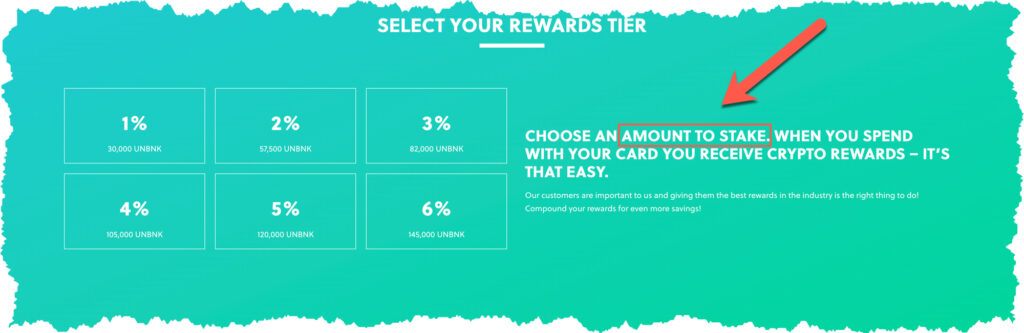
What Are They Doing With Your Bitcoin Behind The Scenes?
As we learned with the Luna death spiral, the bankruptcy of Three Arrows Capital, and the contagion that took down Celsius, Voyager, and almost blew up BlockFi (Update: BlockFi is toast Update 2: Now FTX is gonzo), it’s hard to know what’s going on behind the scenes. Some of these companies are doing sketchy shit with your money, and since they are not regulated banks, it’s very possible that if things go wrong, you could lose all your money.
From the same company, check out this fine print:
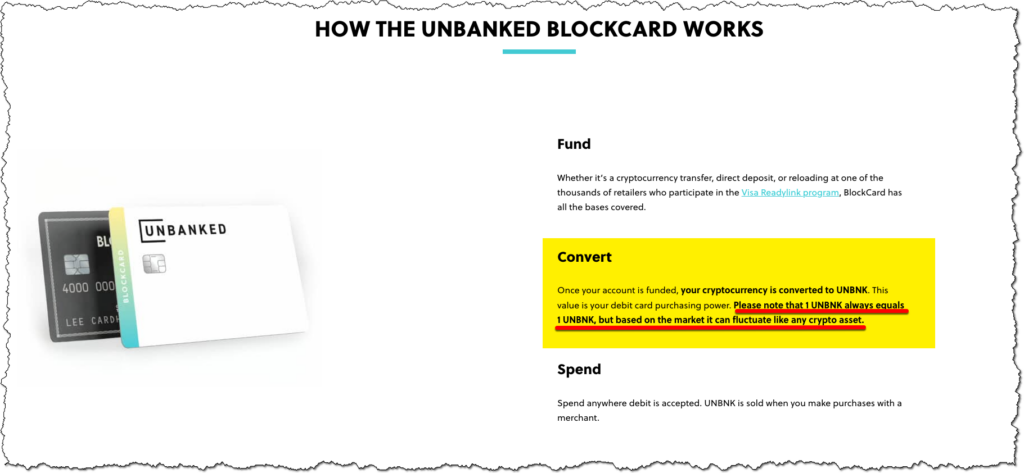
So, what you are getting in this situation is not even a dollar based account. Are you sure you want to sign up to convert your money into an obscure utility token that could go down in value during market crashes?
Another example of a crypto scam to be aware of is how exactly these rewards incentives are paid out. Below, you can see that the Wirex card pays out its rewards in a “loyalty token”, which may or may not have a free floating value, or may be subject to valuation changes at the discretion of the company.
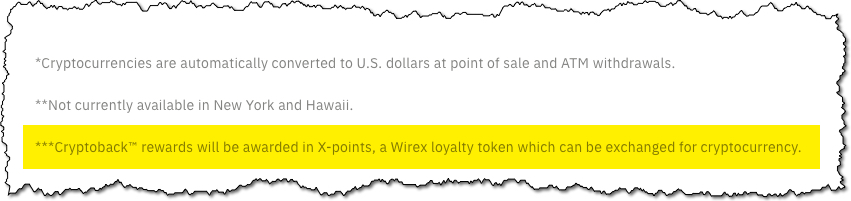
Once a token is involved, all sorts of new variables are introduced. Is the token available on the free market? Can the value of your rewards go down? How often can you exchange it for bitcoin or dollars? Is there a lockup period? Is it a 1-to-1 value?
My advice is to not pick up pennies in front of a steam roller.
Is A Bitcoin Debit Card Even Worth Your Time?
The main question I ask myself is whether or not a bitcoin debit card is actually worth your time. For me, the answer is no. I keep my bank account and bitcoin balances separate to keep my tax filing as clean and simple as possible. If I need to sell bitcoin for costs, I sell a chunk of what I need, for a single reported transaction. I try to not even put myself in the position where I have to sell bitcoin in the first place, but it has happened before where I did actually need to sell to cover some unexpected costs.
A debit card would mean that you need to track every single thing you buy, even a Coke from the gas station, and report any profits you made from the exchange. Even though the net result of these bitcoin debit cards is that you can “spend bitcoin”, the reality is that you’re selling bitcoin for dollars, then spending dollars, so you’ll be taxed on the sale of your bitcoin.
I’d Rather Be Spending Bitcoin
If I’m going to go through the hassle of reporting bitcoin profits, I’d rather spend bitcoin directly and help the bitcoin circular economy.
More importantly, however, in many cases, you need to have your bitcoin on an exchange in order to spend it. When your bitcoin is on an exchange, you don’t hold the keys.
Exchanges may offer incentives to keep your bitcoin on the exchange like interest on your bitcoin, or promise excellent security, but the reality is that if they screw up, your bitcoin is toast. If they get hacked, as was the case with Mt. Gox, your bitcoin is gone and your money may be stuck in litigation for ten years. If they rehypothecate your bitcoin and make a bad trade, they could go bankrupt and use your bitcoin to bail out their company, as with Celsius.
There’s a reason that not your keys, not your coins is one of the first rules everyone learns in bitcoin.
So is the novelty of being able to spend bitcoin at non-bitcoin places worth it to have a bitcoin debit card? For me, the answer is no.
Pros
- keep entire savings in bitcoin, spend as required
- access to bitcoin funds any time
- spend bitcoin balance at a wide variety of businesses
- access to merchants on legacy payment networks even without a bank
Cons
- give up self custody, in many cases
- complicated taxes on profits
- requires extra steps versus saving in bitcoin and spending in fiat
- merchants receive dollars instead of bitcoin
Bitcoin Debit Card FAQ
What Fees Can I Expect To Pay?
Spending from the debit card itself won’t cost you any fees, but the merchant will still likely pay whatever fees are required from VISA, Mastercard, or whatever payment network the card uses. You might be responsible for paying on-chain bitcoin fees if your spending method involves sending bitcoin, and you’ll have to pay any taxes on bitcoin sold, even if you’re just buying a $2 coffee!
Is This The Same As Spending Bitcoin?
It depends who you ask. There is a debate amongst bitcoiners regarding what counts as “spending bitcoin” versus “selling bitcoin”. The best explanation I’ve heard, and the definition I use is that if you are sending bitcoin with the intent of buying a good or service, even if you require dollars as an intermediary medium of exchange, then it’s spending bitcoin. If you are trading your bitcoin for another asset because you think it’s a better investment vehicle, then you are selling bitcoin.
Of course, it comes down to semantics, and in the end it really doesn’t matter what anybody thinks. If you have a stash of bitcoin and it’s available as money when you need it, then it’s doing its job as a store of value.
Do I Need To Qualify For A Bitcoin Debit Card?
With most debit cards, there is no qualification process once you have an account with the company issuing the card. This means you need to have proper documentation to get an account, but getting a card doesn’t require a credit check since you are spending from an available cash balance. If there is a qualification process, it won’t be as strict as the one for getting a credit card.
What Is The Best Bitcoin Debit Card?
Bitcoin debit cards come with a wide variety of features and tradeoffs, so there is no “one size fits all” best bitcoin debit card. My best advice is to use a bitcoin-only company, as those companies tend to get caught up less in crypto schemes like FTX, Celsius, BlockFi and others.
How Do You Buy An Anonymous Bitcoin Debit Card?
The first step to buying a bitcoin debit card anonymously would be to make sure that you are using bitcoin privately by acquiring bitcoin P2P, using UTXO management best practices, and leveraging privacy-preserving tools like coinjoin and VPNs. Then, you would need to acquire a debit card through a service that does not require KYC (know your customer) information such as Pay With Moon, or on the second hand market.
Does Coinbase Offer A Debit Card?
Yes, Coinbase offers a debit card that allows you to spend your bitcoin (and other crypto), though it’s not spending bitcoin directly at merchants. They swap your bitcoin for dollars on the back end, then send the merchant dollars via traditional payment rails. You can also earn cash back rewards, paid out in bitcoin.
What Is A No KYC Bitcoin Debit Card?
A No KYC Bitcoin debit card would be one that you can get without providing private information like name, date of birth, or a government-issued ID number. This is not a common service, and most companies that offer no-KYC services have a limit on the amount or frequency you can purchase debit cards to limit their liability.







 What Is A Bitcoin Maximalist?
Leave a Reply