

It’s hard to talk about bitcoin without mentioning at least some of the world of shitcoin terminology from time to time and this is the case with the term “exit liquidity”, which is largely a shitcoin phenomenon. However, there are definitely some situations where this can apply to bitcoin as well, so it’s worth knowing not only what it means, but how to spot it in the wild, so you can avoid getting rekt (examples below).
In short, exit liquidity is the “dumb money” needed so insiders can exit with profit. Buyers are left holding the bag. It’s a pump ‘n dump.

More Meaning Behind Exit Liquidity

Liquidity refers to the volume of any commodity, currency, or other financial product. If something is “liquid”, it means there is a high volume of trading activity. If you need to buy it, there’s always someone willing to sell. If you need to sell it, there’s always someone willing to buy.
Shares of Apple stock are very liquid. US treasuries are very liquid. Bitcoin is very liquid.
The opposite of that would be “illiquid”, meaning there’s not enough counterparties to buy or sell. So when an insider on one of these shitcoin pump and dumps owns a large percentage of the coin, and they want to sell everything to exit the scheme, there may not be enough buyers to actually soak up all that selling activity. When the number of sellers exceeds the number buyers, the price starts to go down, resulting in what’s known as slippage.
So if the seller wants to sell their shitcoin at $1.00 per coin, and dumps their entire stake, they won’t get $1.00 per share for all their coins. The increased selling activity will cause the price to continue to go down as they sell.
Smart traders will notice this uncommonly high selling activity and also exit their positions, adding to the amount of selling, driving the price down even further.
Shitcoins Are Illiquid Because Nobody Wants Them
All of this is the result of these shitcoins being illiquid.
It’s therefor desirable for insiders to have enough liquidity in their coin to be able to dump coins for profit without driving the price downward.
It’s one tier above rugging, which is a straight up scam where anonymous influencers disappear or coin developers siphon funds to an unknown wallet and the coin goes to zero in an instant.
Insiders need unsuspecting “retail” traders as exit liquidity get out of their worthless coin without spooking the market. The whole process of pump and dump doesn’t work without retail traders to dump on. In other words, ignorant n00bs are required, in order for the scheme to work.
Your Friendly Neighborhood Crypto Analyst
So-called crypto analysts posting their trades online feed into this scheme in more ways than one.
The first way is that they are actually involved in the scheme and own coins that they need to dump. The setup is simple. They buy some coins at a discount, then announce to their audience that they’ve taken a position. Their followers buy the coin en masse, pumping the price, as the influencer exists. The coin peaks, then trends toward zero as everyone loses interest.
The second way is that they are simply paid a flat fee to “analyze” a coin or review it and post their finding. Founders of coins can afford to pay upwards of $50,000 or more for a single review on a big enough channel because they’ll make millions in profit as they exit their positions, dumping shares on new investors. This way, the crypto influencer can claim to have no stake in the coin and not benefit from price movements, but they are still part of the pumpenomics.
Influencers Getting Caught
Here’s one example. In these charts, you can see crypto influencer Scott Melker (AKA the Wolf of All Streets) mentioning coin names on his Twitter near the the top of the price charts, then selling coins, and then the price never recovers. Isn’t it weird that he mentioned coin names exactly at their peak price so many times?
There are many well-known crypto influencers such as Bitboy, Lark Davis, and others who consistently recommend things to their followers that lose them money. Absolute, bottom of the barrel garbage or even outright scams. @ZachXBT is a good account to follow on Twitter to keep up with scams.
These are just the high profile influencers who flew too close to the sun and got called out in a very public way. Many others take a more subtle approach.
I remember one incident, though I can’t recall the specific details, where it came out that an influencer was paid to simply mention the name of a company in a tweet. I believe she said something like, “My friend keeps telling me to buy some [CRYPTO], but it sounds like a scam, what do you guys think?”. Something along those lines. And she was paid thousands of dollars to say that, simply to get the name of the coin out there so it would be more recognizable among the sea of other coins out there.
Sometimes You Get In On The Pump. Sometimes Not
People are desperately trying to make money from crypto trading, and too lazy to do their own research, so they just follow influencers and buy what’s recommended. There are also groups trying to front run dumb money, not realizing they are the mark.
Sometimes, it works out and you make a few thousand bucks. If you bought Doge when Elon Musk mentioned it on Twitter the first time, you might have made some money. Most of the time, it doesn’t. The vast majority of folks lose money. If you bought Doge when you heard about it because Elon was on SNL, then you’d be in the second group.






Venture Capitalists And Other Insiders Love Dumping On Retail Investors
Crypto shills on Twitter are not the only ones who need exit liquidity. This type of scheme goes all the way up the food chain to the billionaire class. A very famous example that went viral in 2021 was a video podcast with a couple of well-known venture capitalists joking about the exact process of insiders buying early at a discount, then dumping on retail as the price pumps.
In this video, you can hear Chamath Palihapitiya explicitly saying that he bought a billion dollars of Solana at a discount (the premine), and he’s hodling…”ish”, implying that he’s doing some amount of selling.
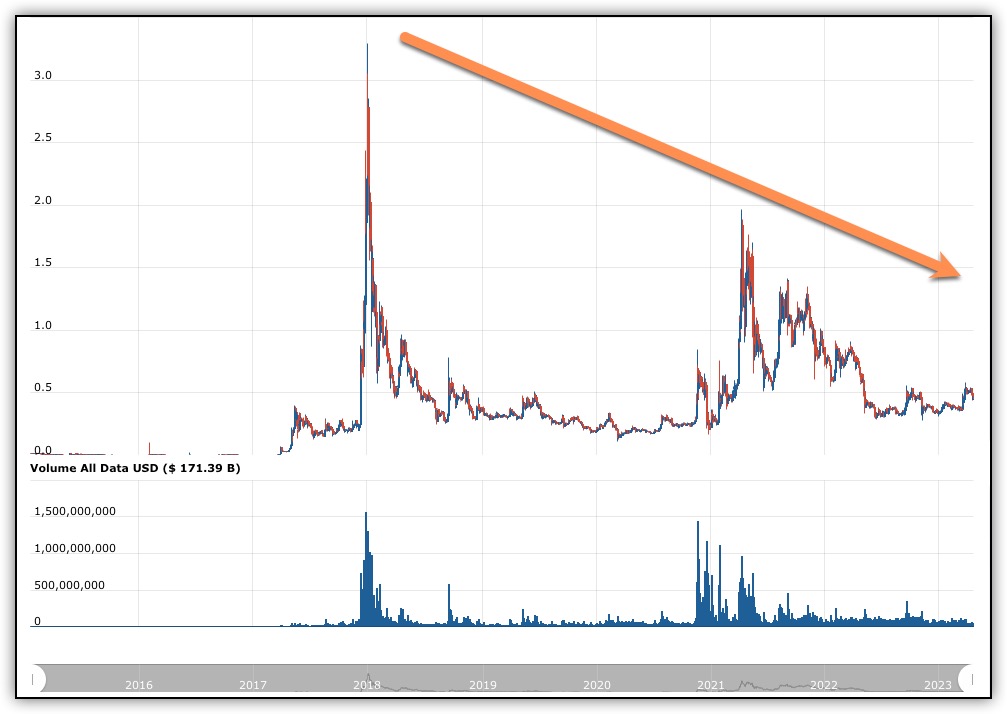
Since then, you can see from the chart below that the price of Solana (price in bitcoin), hit a peak in 2021, and hasn’t recovered.
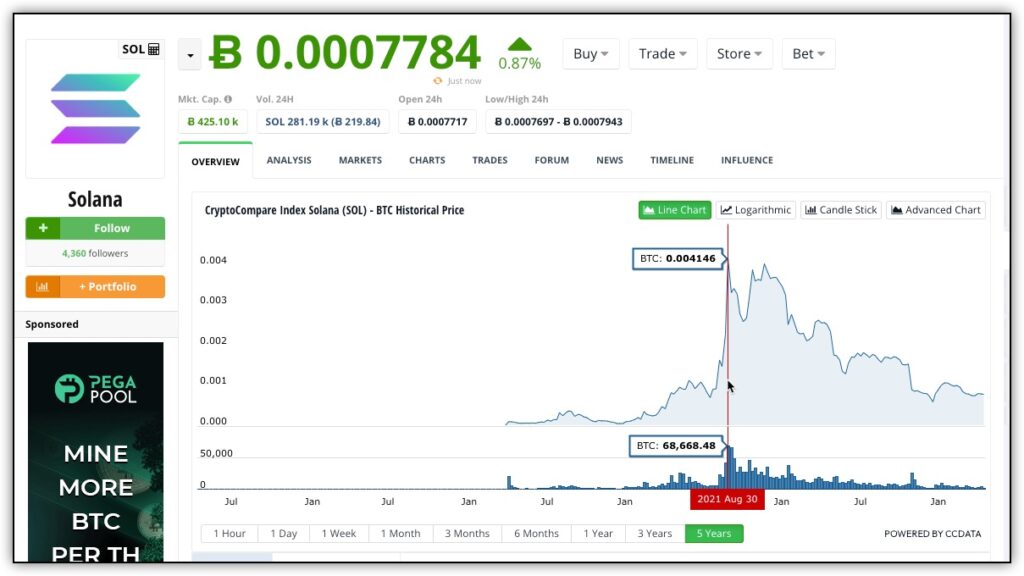
You might be tempted to think that the price could recover in the future, as bitcoin has done many times, but I’d be willing to bet it won’t. Solana was a darling coin of the 2020/2021 Web3 craze. Most high profile coins like this hit a peak during their initial mania, then never recover. It’s a familiar story dating back a full decade.
Litecoin was one of the most popular “alt coins” in the first era, hitting its peak in 2014, and never surpassing its all time high from that period. Ripple was one of the most popular alts in the 2017 ICO mania, and didn’t cross it’s ATH price in BTC in the most recent run. I suspect we can expect the same to happen to Solana.
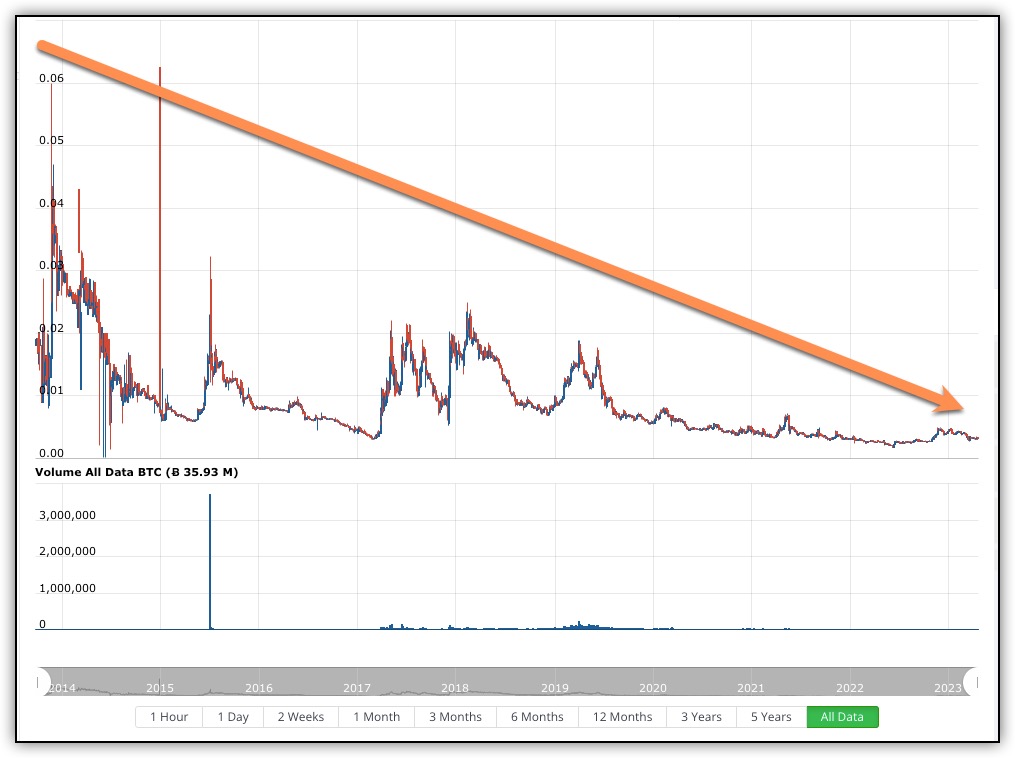
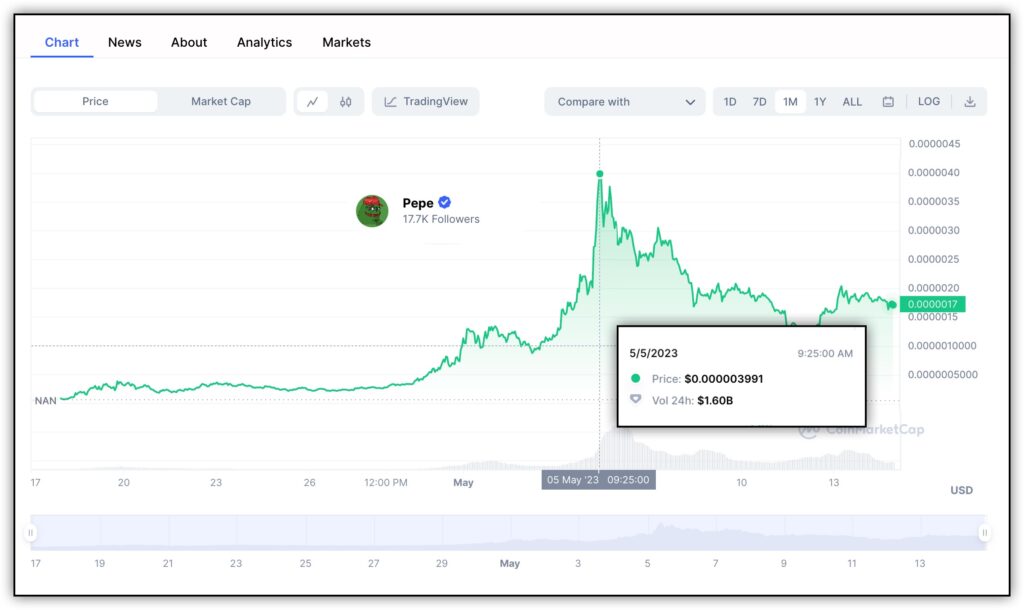
The truth is, if you are buying coins on any kind of well-known exchange like Gemini or Coinbase, you are getting dumped on. Just look at Binance listing $PEPE on May 5th, 2023, and look at the price chart below. Notice the peak price on May 5? What are the chances that insiders have dumped and this coin will never reach its ATH again. Very high IMO.
Exchange Insiders Love Dumping On Retail
There have been many cases of exchange insiders using retail traders as exit liquidity. Although only one specific insider that I can think of was ever charged, it’s happened many more times.
The first example I can think of was the curious case of Litecoin being added to Coinbase, America’s #1 crypto exchange. You can click the previous link for details, but the gist is that the main coder and proponent of Litecoin was working at Coinbase when the coin was added. He quit Coinbase just a month after the coin was added, and sold all of his Litecoin stash at the all-time-high. All out in the public. No joke.
Then again, at Coinbase, the launch of Bitcoin Cash was extremely suspicious as well. The accusation is that Coinbase tipped off its own employees that BCH was launching, so basically insider trading. What’s nuts is that the price of BCH hit $3600 a day after launch, and never recovered. It’s now about $119 USD and is at an all-time low when priced in BTC.
Then, of course, is the case of FTX, and who knows how deep the fraud goes with this one. Their native trading token FTT was the root of a lot of scammy stuff, but that’s not all that was going on. Apparently, there are at least 18 cryptocurrencies for which FTX facilitated their sister investment arm Alameda Research to trade against FTX customers using customer data from the FTX exchange.
Summed up, FTX was working to get their customers to lose money, because it doesn’t matter if customers lose money when you make money on every trade. So FTX was earning on trading fees, and Alameda was cashing in by dumping on FTX customers.
Keep in mind, these are/were two of the biggest and most well-known exchanges in the world.
Everyone Is A Scammer
There’s a saying in bitcoin: everyone is a scammer. Although its original meaning, was more tongue-in-cheek, as a commentary saying that bitcoiners shouldn’t so easily part with their bitcoin for sketchy investments or shiny trinkets, it’s a good framework to operate from when applied to bitcoiners trying to fleece other bitcoiners though poor investment ideas or outright fraud.
One of the most popular scams in bitcoin is known as the affinity scam, whereby a brand (person, company), builds a strong reputation among bitcoiners, then uses their reputation to promote a low-quality product or outright scam from which they profit. Make no mistake, that offbeat project they’re “interested in”, is gonna dump, and you are the exit liquidity they need.
One early example was Trace Mayer, who famously shilled Mimblewimble Coin at bitcoin conferences, a coin with a whopping 50% premine. What are the chances that he had a stake in MWC? He built his reputation among bitcoiners for years, and threw it all away to shill a shitcoin at a bitcoin conference.
Another, more recent example was Robert Breedlove, who launched a very public “investigation” into a token/platform called Bitclout using his Twitter. Soon after, the Breedlove22 token pumped as his followers started to buy in.
Surprise, surprise, a short while late the price tanked as Breedlove dumped his own shares in the the coin.
In the end, he donated the profits to bitcoin developers and eventually admitted that he messed up, but it’s still a great example of how you really should be making your own decisions about what to invest in, especially in the world of bitcoin.
The lesson is clear: If someone is shilling something, consider for a moment that you are the exit liquidity.
How To Not Become Someone Else’s Exit Liquidity
Now that you’re aware of the dangers of exit liquidity, how do you make sure that you don’t fall into this trap? There is one really, really simple solution: Don’t buy shitcoins. Any of them. No matter how cool the project sounds, or how good the dev team is, or whatever other reason you can think of.
By the time you can actually purchase the coin, the pieces to the game are already set. Insiders already got in on the presale before the thing even launched, and they’re looking to sell when the price gets high enough.
If you weren’t in on the presale, then you are the exit liquidity
something i saw on twitter
Shitcoins are never a “buy and hold” type situation like bitcoin. It’s a game of hot potato, and you’re just hoping you make some money and get out before everyone else. Will you exit on this pump, or the next?
Some people enjoy playing that type of game. Sometimes they gamble and win. Most people lose their asses.
Bitcoin Was A One-Time Thing…
There can never be another “fair launch” of a token because the whole world knows about cryptocurrency now. When bitcoin launched, it was just the nerds and idealists who adopted bitcoin out of pure altruism and curiosity. Millions of coins were lost due to experimentation and carelessness simply because bitcoin was worth nothing and most early bitcoiners never imagined that it would become such a big deal.
Did insiders control bitcoin in the early days? Absolutely! But there was nothing at stake. The entire Bitcoin network literally had a market cap of between $0.00 and a few thousand dollars for almost a year.
Was bitcoin vulnerable to attack? Yes. Definitely. But it was never seriously attacked because nobody cared enough to attack it.
These days, everything is different. A centralized launch means there’s insiders looking to profit. A fair launch means it’s vulnerable to attack by advanced crypto mining technology. The landscape of launching a coin is much different in 2023 than it was in 2008.
There is NO next bitcoin.
The reason that these insiders are able to find exit liquidity and dump on retail is that there are still folks trying to get rich quick by finding the next bitcoin. Everyone has a “I should have bought more bitcoin” story, and the regret is too much to handle. So instead of understanding the principles of why bitcoin has value and just buying some fucking bitcoin, they get hung up trying to find the next parabolic investment and get scammed in the process.
Figure out why bitcoin matters. Stay humble and stack.
Frequently Asked Questions
Is Liquidity Good Or Bad In Crypto?
Liquidity in crypto is good, because it means that there are many people buying and selling a coin. You can always find a buyer or a seller. Bitcoin is the most liquid crypto asset, and you can buy or sell bitcoin at any time of day, on hundreds of exchanges, in every country in the world.
What Is A Liquidity Event?
A liquidity event is a term used in traditional finance that describes a time when early investors are able to “cash out” their shares so that other investors can buy in.
Can You Pump And Dump Bitcoin?
Bitcoin is too large of a market cap to effectively pump and dump the price. The number of people and amount of capital required to pull something off like this would be too large to effectively keep a scam of this magnitude secret. There have been several instances of social media influencers being suspected of trading with or against their followers, but nothing has ever been proven, or been shown to be effective/profitable.
Are Pump And Dumps Illegal In Crypto?
Pump and dumps are 100% illegal in the traditional stock market, but pump and dumps for crypto are still in a grey area. It’s unclear if participating in a pump and dump versus organizing one versus facilitating one (exchanges) would carry what type of legal punishment. It’s very likely that if something like this ever went to court, there’s an argument to be made that knowingly trying to pump the price of a scam so you can get people to lose money is effectively fraud.









 Top 7 Green Energy Sources To Mine Bitcoin
Leave a Reply