Now that you’ve decided to buy some bitcoin, you’ll probably deal with a bit of “bitcoin time machine regret”. This is the part where you beat yourself up that you didn’t buy sooner. You feel like you missed the boat, right? Lots of people have this feeling, so you aren’t alone. However, it’s important that you don’t let it lead to YOLO investments into non-bitcoin cryptocurrencies.
I went down the same path, and eventually came back around to a bitcoin only mindset, so I want to walk you through my logic of how I came to that conclusion. Hopefully, I can save you some time and money in the process.
My Own Bitcoin Time Machine Regret
The first time I heard of bitcoin I was living overseas and had some money saved in a local currency. I was concerned about the capital controls of the country and how I was going to get my money out when I decided to leave. I still don’t remember how, but somehow, I stumbled across Bitcoin.
With a basic understanding of how it worked, I figured that I could create a bitcoin wallet, convert my savings into Bitcoin, then travel across the border with a scrap of paper with my seed on it. Nobody knew what Bitcoin was, and I could easily hide the paper between my credit cards or laminate it and hide it in my sock.
The year was 2012, so Bip39 seed phrases weren’t invented yet. That would mean I wouldn’t be able to memorize the words and restore the wallet. I’d have to write down a crazy string of numbers and hope it worked when I got across the border.
After looking into Bitcoin for a bit, I got spooked. I wasn’t as tech-savvy back then and was on a used Windows laptop I bought at a popup hardware shop, so was worried that I had some dormant malware that would swipe my coins. Also, what if I wrote the phrase down wrong, or the paper got wet/smudged? It was too complicated, so I ended up doing it the traditional way through banks.
I had about $6,000 USD in savings that I had originally considered converting into Bitcoin. Had I done that, it would now be worth over 48 million dollars. If you haven’t already, you can do a similar calculation at Coin Time Machine.
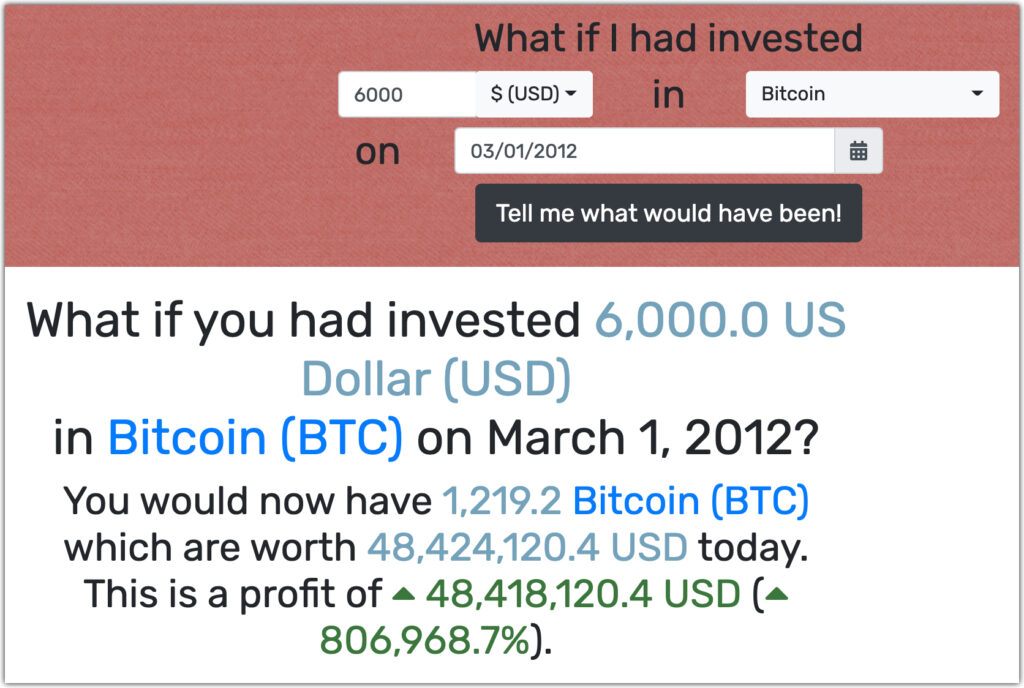
Looking at a number like 48 million dollars, it’s easy to be filled with regret.
If only I had taken action!
If only I had bought and held, I’d be set for life!
The truth is that this is a logical fallacy and you’re beating yourself up for no reason. There are a lot of things that would have happened between now and then. Realistically, you’d probably be in exactly the same situation you are in right now – wishing you hadn’t sold your coins so early.
The good news is that you’re here now, ready to start, or start again.
With that said, let’s look at what probably would have happened and why you should forgive yourself and stop regretting that you don’t have a Bitcoin Time Machine.
You Probably Would Have Sold Out Anyway
Bitcoin has popped in and out of media conversations a few times throughout the years as the price skyrocketed and dumped at various times. You likely read an article about it or heard a friend talking about buying some. Maybe you heard about The Silk Road, or Wikileaks accepting Bitcoin.
Now that we’re living in the present time, it’s easy to think back to the past and imagine how things would be different if you had made different decisions. This is what regret is.
Related Content



How Much Bitcoin Would You Actually Have Bought?
In a hypothetical situation where you actually YOLO’d into bitcoin at $1 or $10 per coin, how much cash did you realistically have on hand then? $1,000? $10,000? Would you have really dumped every spare bit of cash you have into a new thing called a “cryptocurrency” that was associated with government hacking (Wikileaks) and buying drugs online (Silk Road)?
Then, let’s say you didn’t mind the criminal stigma of Bitcoin at the time, because there definitely were lots of smart people at the time saying that Bitcoin goes deeper than just escaping government control. Bitcoin is about freedom, and you love freedom. The next question is, when would you have sold?
Just to make the math simple, if you bought $10,000 worth of bitcoin in 2011 and paid $1 each, you would have had 10,000 coins.
You would have been a millionaire by 2012. Would you have sold?
You’d have $10mil net worth by 2013. Would you have thought the ride was over, and peaced out?
Let’s not forget the possibility that you sold 10,000 coins at $100, watch the price run up to $1,000, then bought back in, only to see the price crash to $100. You’d now have 1,000 bitcoin instead of 10,000, and you’d be super pissed off. Would you rage quit with $2 million USD? The price of bitcoin wouldn’t return to over $1,000 USD per bitcoin until 2017.
Would your conviction be strong enough to hold onto 2 million dollars worth of magic internet money for 4 years while every normie around you is telling you to sell?
Now imagine this cycle repeating at the price runs up to $20k, then drops to $5k for 3 years from 2018 to 2021. The price is around $50k as I write this. Would you sell now and cash out forever, or hold on tight during the run up to $100k per bitcoin. $1,000,000? $10,000,000?
Also, so what if you made a million dollars?!
Would You Have Sold Your Bitcoin For A Million Bucks?
Unless you’re 80 years old, that million dollars isn’t going to last you the rest of your life. You still have to keep working your job and keep a million dollars in the bank, or invest it wisely into a conservative stock index like the S&P 500 so you can retire at 50. YOU CAN NEVER TOUCH THE MONEY because if you spend your principle, it won’t compound and grow. Living off 7% interest of a million bucks means you get to spend maybe $30k/year.
Good deal, but you’re not rich.
Either that or you can buy a nice house, car, and vacation and you’ll have nothing left. Subtract state and local taxes on the sale of $1mil profit you’ll have about $500k left. You can spend $400k on a house, $50k on a nice car, $10k on a vacation, and have $40k left over in the bank. BTW, your house won’t be some amazing land with mineral rights or a penthouse in NYC. It’ll be a basic 3/2 home built in the ’70s.
Now you have a yearly tax bill for your home, and you still have to pay for heating, water, and garbage. You still need a job.
To recap, even if you bought bitcoin early on
- You probably wouldn’t have enough
- You probably would have sold early
- You probably would be in a similar financial position today
- You still wouldn’t understand bitcoin and would hesitate to buy more
Learning about how Bitcoin works has been extremely useful to my own conviction with buying and holding the asset. The more I learn about it, the harder it becomes for me to justify putting my money into anything else. Everything has tradeoffs, and my understanding the tradeoffs of bitcoin the asset allows me to buy and hold with confidence.
Would You Have Survived The Fork Wars?
I wasn’t around in Bitcoin’s early days, but as far as I understand, there have been a few moments in Bitcoin’s history where even the OG’s paused and thought, “Oh shit, it might really be over”.
There was the Silk Road takedown in 2013, and people thought that Bitcoin would simply become illegal. Then there was Mt. Gox hack in 2014. Then there were a few years of stagnation where not much happened, and it seemed that enthusiasm for bitcoin was waning. During that time period, bitcoin spiked to $260, then down to the mid $60’s. Then up to $1,000 a year later, and back down to the low $200’s. These were some of the worst crashes to bring up, but what’s worse than a crash is a long-term bear market.
There were many hard forks between 2009 and 2020, with each claiming to be the real Bitcoin, or be a better Bitcoin. Would you have kept following the $BTC ticker, or would you have jumped ship to something else like $BCU, $BTG, $BCH, $BCD because you wanted to get in early on “the next Bitcoin”?
There were times where respected bitcoin core coders rage quit and said that Bitcoin has failed. Would you have followed their advice and sold all your bitcoin?
You don’t have to be a Bitcoin historian or Shadowy Super Coder™ to understand why Bitcoin exists and to make educated decisions about it.
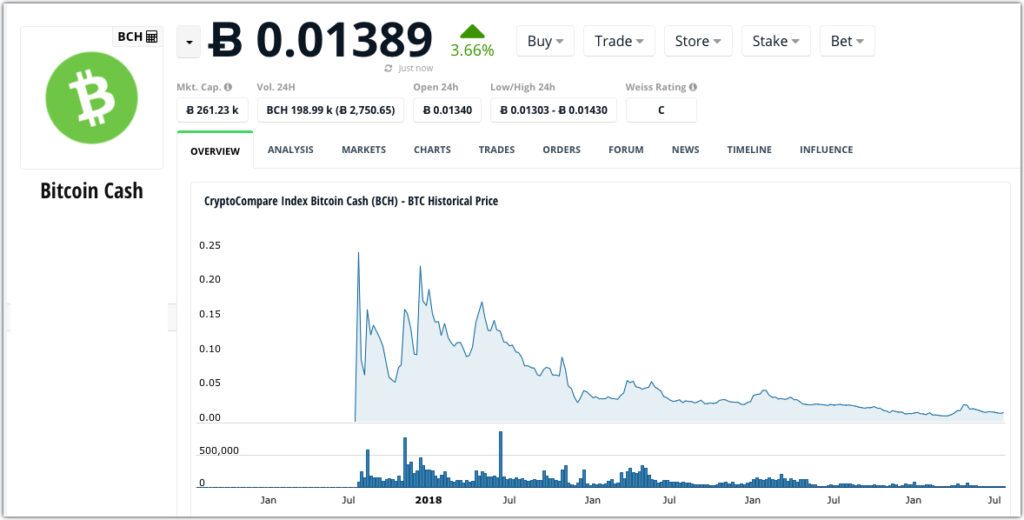
Without an understanding of Bitcoin basics, it’s possible that you would have made the wrong move. Many people did. Although they might be “up” in USD terms, they lost value in BTC terms. For example, if you had followed the $BCH fork instead of $BTC, here’s what the value of your money would look like.
There Is No “Next Bitcoin”
Nothing like Bitcoin has ever been invented before, so it’s hard to wrap your mind around certain concepts. One of those concepts is that there will never be a “next Bitcoin”. It was a one-time invention. Bitcoin is Bitcoin.
A typical reaction I get when I say this is something like, “Oh, you just say that because you’re invested in Bitcoin. What if Bitcoin ends up being like Myspace, and we’re waiting for the Facebook of Bitcoin? What if something comes along that’s faster, cheaper, and better?”.
In my opinion, this is the wrong framework to think about Bitcoin, so let me try to reframe it.
Bitcoin Is An Invention, Not An Innovation
Thinking of Bitcoin in comparison to Myspace and Facebook is looking at Bitcoin as an innovation, which is the wrong framework to start from. Facebook was an innovation on existing technology. They improved the Myspace experience by having a great mobile app and connecting people in a different way. Myspace was an innovation on text forums. Text forums were an innovation on letter writing and in-person meetings.
Even something as groundbreaking and world changing as the iPhone was just an improvement on the telephone combined with a mobile computer.
Bitcoin, on the other hand, was an invention that never existed before. You might think that it’s just a “better PayPal” or “better dollar”, but it’s deceptively more than that.
Bitcoin is digital money with no central authority. Real value attributed to a natively digital asset. Money that can’t be confiscated or controlled by anyone. This has never existed in human history.
You can’t invent that twice.
The full scope of Bitcoin’s influence on the world has yet to be seen, but it’s been compared to the number zero and the printing press.
You can copy Bitcoin and make another Bitcoin-like thing, but that’s not the real Bitcoin. It’s a Bitcoin copy, and everyone knows that.
Bitcoin Is Money, Not An App
Bitcoin is where people store value in the digital space. Sure, there are a lot of coins out there that have decent market caps and trading activity, but they aren’t where people park their money for safety, and that says a lot about what value those other cryptocurrencies really have. The vast majority (if not all) of other cryptocurrencies are basically just memes being traded online.
If you ask any crypto traders what their goal is, usually, it’s to acquire more bitcoin. Bitcoin is their store of value. Bitcoin is their unit of account. Bitcoin is their money.
What would it take for the entire cryptocurrency industry to make the switch to something else?
Switching money is not like switching email apps. It’s not even like switching from Android to iPhone. Your life’s energy is stored in that thing. You’ve done the research and committed to storing it there because you have strong conviction in it.
Comparing it to the stock market, think about if you invested in $AAPL stock. Would you put your life savings in $AAPL? Probably not. At some point, you may find another tech opportunity, like $AMZN or $NFLX. When all is said and done though, at the end of the day you withdraw your money to dollars (or local currency).
In that scenario, USD is your unit of account. USD is your store of value. It’s where you put your saved, excess energy because it’s safe. What would it take you to withdraw your money to some other type of money?
Think about where you keep the bulk of your money right now. Are you mostly in cash? Mostly in index funds? What would it take for you to move that to another financial instrument?
You may view Bitcoin as risky, but most people in the crypto economy do not – especially bitcoiners. Nobody puts their life savings in Dogecoin and expects to keep it there for 100 years. Stuff like that is people just doing quick trades to try to time the market and beat bitcoin’s returns.
In fact, hardcore bitcoiners see bitcoin as a superior store of value even compared to US dollars because it can’t be manipulated by any central authority. It may seem like a crazy concept to keep your savings in Bitcoin instead of dollars, but you may change your mind as you learn more about Bitcoin.
The overall point here is that Bitcoin is money. It may not be a money you understand or believe in right now, but it’s money to millions of people in every country across the globe. It would be very difficult to get them to change their mind and start using a different kind of money.
Bitcoin Can Be Upgraded, And Has 2nd/3rd Layer Capabilities
What if a new technology came along and was faster and cheaper than Bitcoin? Would that make people change their minds and switch to something other than Bitcoin? Anything is possible, but it’s unlikely.
The invention of Bitcoin was path-dependent, meaning it’s unlikely that another coin could come along and become bitcoin in the same way. Part of Bitcoin’s success is that nobody knew what Bitcoin was at the time. Its distribution was fair. It was not attacked because it was out of the limelight. Errors were fixed before they could be exploited.
Now, that everybody’s looking for “the next bitcoin”, that path for success has been closed off. Any new coin would have to surpass Bitcoin’s success with a new path.
In the meantime, Bitcoin has the option to absorb new technologies.
The cool thing about Bitcoin is that even though it’s very hard to change (and that’s a good thing), with enough motivation from the community, it is possible to change. Bitcoin has been upgraded many times over the years. For example, in the early years of Bitcoin, it was very difficult for users to store their private keys because it was a long string of random numbers and letters. Printing this number or storing it digitally was a potential security issue and writing it down by hand was ripe for mistakes.
So BIP39 was introduced, and it gave users the ability to create a 12-24 word “seed phrase” which they could write by hand, memorize, or engrave into steel for future recovery.
As recent as 2021, an upgrade called Taproot was merged into the core protocol (Activates Nov. 2021), which will give users more privacy when transacting (among other things). There are many other proposed upgrades to Bitcoin in the pipeline. Getting them implemented is a long and often contentious process, but it is possible.
In terms of absorbing technology, the best example was when Litecoin implemented Segwit in 2017, then Bitcoin implemented it shortly after. Adding Segwit to Bitcoin made the lightning network possible, making instant and near-free payments in Bitcoin possible.
Even if the Bitcoin base layer protocol can’t be changed to integrate this “amazing feature”, there will most likely be an option to implement it on a second or third layer protocol. To me, Chaumian mints on lightning sure sound a lot like Monero’s privacy method, which is basically hiding in a crowd. A more technical person might dispute that description, but you get the point.
The possibility of implementing features on Bitcoin’s second or third layer is often overlooked. Even if changes to the base layer protocol can’t mimic some other coin features, you can still build it “on top” of Bitcoin.
For example, in the ICO craze of 2017, people went crazy for the idea of creating your own “tokens” using Ethereum. The idea of creating “colored coins” has been around in Bitcoin for quite some time.
Colored coins on Bitcoin ultimately didn’t work out, partly because there wasn’t a real use case for them and development atrophied as developers moved onto more interesting and important projects. The ICO bubble in Ethereum ultimately popped and never came back, so I guess they figured out that there wasn’t a ton of use for all those tokens either.
In 2020 and 2021, NFTs were the craze on Ethereum. What a lot of people know is that you can create NFTs on Bitcoin too. Again, Bitcoin did this years before Ethereum, most famously with Rare Pepes. The market got saturated, and pretty much like Beanie Babies, peaked then crashed, and never really returned. I’m writing this in the middle of 2021 and NFTs are still popular, but I can see the market saturating as people realize you can create an infinite amount of “rare” imagery, and owning the hash of the URL of an image isn’t that interesting compared to owning physical art.
Bitcoin Isn’t Just Going to “Go Away”
Right now, there are millions of people spending huge amounts of time and money strengthening the Bitcoin network by investing in infrastructure and building the tools to make it easier for more people to buy and use bitcoin. There are people dedicating their entire lives to niche areas of Bitcoin like off-grid natural gas mining, hardware wallet development, and even satellite access to the timechain. Each one of these individual actors is hyper-focused on seeing the success of Bitcoin as a whole.
Each day that Bitcoin survives, another person gets onboarded, and their life becomes entangled with the Bitcoin protocol. We’re already hitting the point where people can start to say that they’ve “been in the bitcoin space for more than a decade”. What happens when that turns into two or three decades?
You don’t just work in an industry for three decades and then watch it melt down from the sidelines.
It’s highly unlikely that bitcoin would go to zero and you would never hear about it again. The idea of Bitcoin is too important. The world was forever changed with the invention of Bitcoin.
Like the Gutenberg printing press sparked the revolution of separation of church and state, Bitcoin is our chance to separate money and state. Money they can’t print. Money they can’t confiscate. You can’t just un-invent the idea of the printing press. You can burn the press to the ground, but the books it printed live on.
Bitcoiners working in the space long-term get that. This is our shot – not some shiny new bullshit invented in Silicon Valley last year.
What If There Really Was A Next Bitcoin?
A whole bitcoin cost less than $1 in 2011, but it was a risky thing to buy at that time. It seemed like some crazy hacker money that would fade out with disinterest or get stomped out of existence if it got too big. It’s less risky in 2021 now that Tesla and other publicly traded companies own bitcoin, along with US senators and millions of average citizens across the globe. Less risk means higher price.
That’s generally how investing works. More risk = more reward. Less risk = less reward. Makes sense, right?
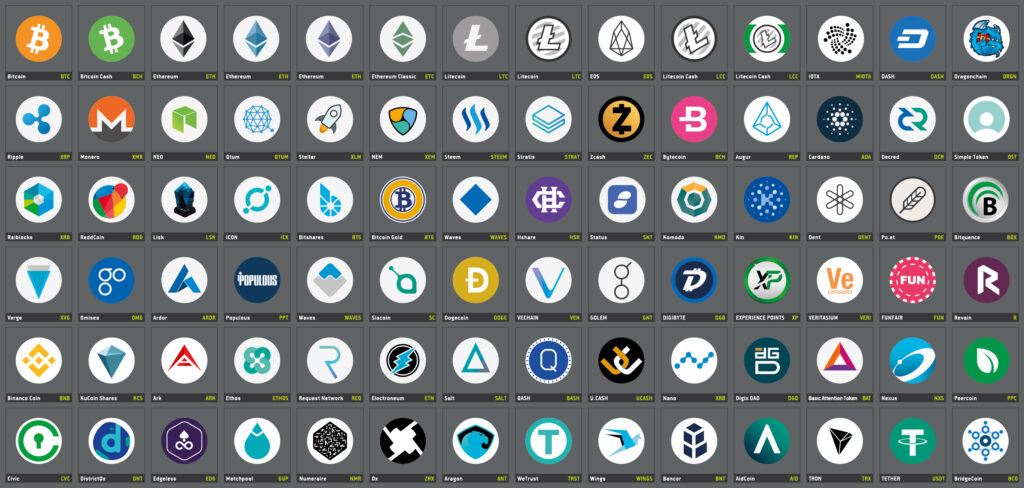
However, consider that if you invested in some new coin in 2021, you’d have to take that same kind of risk of Bitcoin in 2011. It would be a MASSIVE bet to pick one out of 50,000 coins and land on the right one, which just so happens to do the very unlikely thing of surpassing Bitcoin as the most used cryptocurrency in the world.
Are you that savvy of a “crypto enthusiast” or global macroeconomist that you feel confident you could accurately make such a guess AND dedicate a big chunk of your savings to that coin? Probably not. Most likely, you’ll throw a few hundred dollars at some random coins you heard about on Reddit – assuming they’re available on a popular exchange like Coinbase.
Bitcoin has had an insane run-up in price since its inception. From $0.01 to almost $100,000 per coin, if you had invested just a few thousand dollars near the beginning, you’d be one of the richest people on the planet. You didn’t though. You missed that ride, so it must be over, right?
This feeling of missing the boat leads a lot of people to believe that in order to catch that same run-up again, they need to find the “next Bitcoin”. Somehow, the monkey logic in our brain tells us that if the price of bitcoin increased 10,000% once, it’s unlikely to happen again. We convince ourselves that the most likely thing to happen is that some other, new coin would instead follow that same pattern.
For someone unfamiliar with Bitcoin, it may seem like the insane price run is over. Nobody knows what the true value of a bitcoin is because something like this has never happened in history – ever. While you might think a fair valuation for bitcoin is right around the price today (somewhere between $10,000 and $100,000), it’s unlikely you would have guessed that in 2015.
Most people couldn’t have guessed it. You probably would have said the true value of bitcoin is somewhere between $100 and $1,000. Before that, you probably would have said that the true value of bitcoin is probably fair at about $1.
It’s all guessing and personal bias until you really dig deep and find justification for a specific valuation.
People make this same mistake in the stock market. They’ll look at the parabolic rise of a stock price for Netflix or Amazon and think it’s over. Oh well, only 7% growth from here on out. Instead, they’ll throw money at random biotech penny stocks they read about in a forum with hopes to hit it big. This company will be the Amazon of biotech!
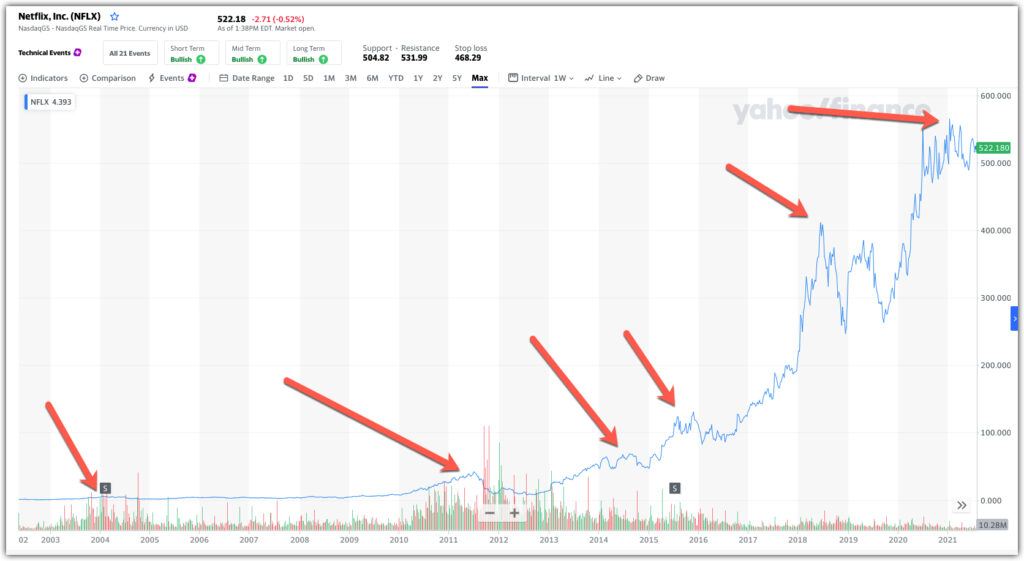
That logic doesn’t make sense though. Big companies have more money, more brains at work, more network connections. Success snowballs. The more you win, the more you keep winning.
The chance of some tiny little company executing perfectly, and getting all the money they need, and the product market being a perfect fit, and all the regulation going in their favor, etc. whatever other headwinds land on their lap is very small. Most companies don’t end up like Amazon.
In my opinion, no cryptocurrency will end up like Bitcoin.
Once you find the winner, buy it and hold it for as long as it still fits your investment thesis. If your goal is to buy and hold hard digital money, then the answer is Bitcoin, and you should keep it until you find something better (which I don’t think will happen).
What’s Your Reason For Buying Bitcoin Anyway?
If your goal in buying bitcoin is to magically transport yourself back in time so that you can invest $1k and become a millionaire, then you’re going to be very disappointed. If you just want to wish upon a star that you were a millionaire right now and didn’t have to work for the rest of your life, well, that’s not going to happen.
That’s why it’s important to understand what Bitcoin is, and why people buy it.
Bitcoin is not a magic button to make you rich and change your life. Bitcoin is a savings technology. Bitcoin is a way to store your energy across space and time. Bitcoin is a global final settlement network and payments rail.
If you don’t need Bitcoin for those things, then it’s not going to solve any problems for you.
Since this post is about “time machine regret”, I’ll specifically address the store of value and purchasing power aspect of bitcoin. A lot of people want to get into Bitcoin to make money, and that’s OK!
The reality of the situation is that you have to start somewhere. Regretting that you weren’t a cypherpunk in 2009 is useless. Instead, become a bitcoin owner today. Start now. Get some bitcoin. Your future self will thank you.
Most people learn about bitcoin “late”, then start buying, and keep buying until you wake up four years later and someone else is complaining that they’re too late to the party. Meanwhile, your bitcoin has 3x’d in purchasing power, and then it clicks. “Oh, I need to buy and hold long-term. It didn’t matter if I bought it at $12k or $16k, because the price is now $50k.”
If you’re getting into Bitcoin to get rich overnight, you’re in it for the wrong reasons. It’s just not going to happen. If you’re in bitcoin because you think it’s a great store of value, then you should be dollar cost averaging your savings into Bitcoin. Work your normal job, pay your bills, and save money.
When you save money, you can decide whether you want to save it in fiat money, which loses purchasing power over time, or hard money like bitcoin.
Everyone Buys Bitcoin At The Price They Deserve
I’m sure you feel like if only you had been at the right place at the right time, you could be rich from bitcoin right now. Lots of people think early bitcoiners are all rich, but the truth is that if you didn’t put in the work, even if you were at the right place at the right time, you probably wouldn’t have bought. Even if you bought, you probably wouldn’t have held. Even if you held, you probably wouldn’t have held that long.
Even then, you might have still fucked it up somehow. Who knows?
The point is that without learning about how Bitcoin works or why it even exists, you’d still be in the same situation you are right now: wishing you had done something different.
Now is the time to stop wishing and start doing. Start (or continue) your bitcoin education so you can figure out why people care about this thing so much. Do you actually need bitcoin?
There’s a saying in Bitcoin Land that everyone buys bitcoin at the price they deserve. What that means is that if you put in the work to understand this incredible technology, you’ll actually understand why it’s valuable, and you’ll be able to accurately assess whether or not you want to buy it, how much to buy, and when to buy.
Naturally, the most well-researched bitcoiners will say it’s always a good time to buy bitcoin 🙂
Further Education
- Pizza Day, A Day Of Regret And Fantasy (Bitcoin Magazine Article)





 What Is A Bitcoin Citadel?
Leave a Reply