
Many of us dream of retirement. The day where we can stop “working”, and start doing something else. Even if you love your job or own your own business, there will likely be a point in your life where it’s time to relax and take your foot off the gas.
For bitcoiners daydreaming about the price of bitcoin in 10, 20, or 30 years, there’s no doubt that bitcoin will be part of our retirement plan. So how do you retire on bitcoin, and how much bitcoin do you need to retire?
Depending on your view of bitcoin and how you use bitcoin, there’s more than one way to retire on bitcoin.
3 Ways To Retire On Bitcoin In Investment Accounts
If you’re wondering whether you can tuck away Bitcoin into your retirement nest egg, the answer is yes. In the US, Individual Retirement Accounts (IRAs) can house various investments, including Bitcoin.
Traditionally, an IRA gives you access to a vast range of investments, namely equities, bonds, mutual funds. But then, along comes the self-directed IRA, widening the scope of what can be held within an IRA, including real estate, physical precious metals, businesses, and now Bitcoin.
So, how does one go about holding Bitcoin in an IRA? You’ve got a couple of options. The first one is to invest in Bitcoin-like investments available on the stock market. Here, you’re not buying the real thing, but investments that mirror Bitcoin’s performance. Of course, these investments are not bitcoin, and come with tradeoffs.
The main tradeoff is that you don’t actually own the physical asset. To use it like money, you have to sell it for dollars, which could take several days to settle in your bank account. Furthermore, if the bitcoin-like fund or stock you own doesn’t manage their assets properly, you could end up with a lower return on investment than real bitcoin. If you choose to invest in something like bitcoin miners, your investment could even go to zero.
Below, I list some examples of Bitcoin ETFs and ETF-like investments as well as individual stocks related to bitcoin. It’s not an extensive list, but you can see many more options in my list of bitcoin stocks.
1. Track The Price Of Bitcoin With Bitcoin ETFs
As of August 2023, there are no true bitcoin ETFs on US equity markets. You may be able to invest in foreign bitcoin ETFs or stocks which track the price of bitcoin in some other way.
Grayscale Bitcoin Trust ($GBTC):
The most popular way for Americans to track the price of bitcoin in a brokerage account is with GBTC. Shares of the Greyscale Bitcoin Trust are purchased and held by qualified investors, but then GBTC, which represent shares in the bitcoin trust, are traded on the secondary market (your brokerage account).
While the dynamics of how the company works aren’t exciting, it is relevant. Because investment in the trust is a one-way investment that cannot be redeemed unless certain circumstances are met, the shares traded on the secondary market trade at their own price. When there is high demand for GBTC, they can trade at a premium (higher than the price of bitcoin). During a bear market when people want out, shares trade at a discount to the bitcoin price.
While owning shares of GBTC is convenient, it exposes you to risk with Greyscale and DCG (Digital Currency Group), which have been in some hot water ever since 2022.
Purpose Bitcoin ETF ($TSX:BTCC)
Purpose Bitcoin ETF is a Canadian ETF and the world’s first Bitcoin ETF that provides direct exposure to physically settled Bitcoin. This is a spot bitcoin ETF will track the bitcoin price much more faithfully than GBTC, but comes with its own issues.
First, you may find that BTCC is not available on your brokerage. BTCC a Canadian ETF, so is only available on select exchanges.
Secondly, you become exposed to Canadian political risk. Considering controversy around bitcoin’s energy use and environmental impact, it’s possible that the ETF may experience issues in the future due to Canadian political action.
Lastly, even though the bitcoin ETF actually owns real bitcoin, it’s still possible for the company issuing the ETF to go bankrupt. In that case, your shares would be liquidated and you’d be liable for any taxes related to the sale. While it’s unlikely for your investment to go to zero since the physical bitcoin would exist, your settlement may be paid out in dollars, and may be tied up in litigation for some time. Though unlikely for long-standing ETFs, I would say that the risk of this happening to a bitcoin ETF issuer is greater than zero.
VanEck Vectors Bitcoin Strategy ETF ($XBTF)
XBTF doesn’t even directly invest in Bitcoin. It invests in bitcoin futures contracts, this ETF’s main focus is Bitcoin futures contracts, aiming to track Bitcoin’s performance indirectly. The goal is to track bitcoin’s price as closely as possible, but it’s currently not possible to have a spot bitcoin ETF in the US. They use the next best thing: futures contracts.
Again, this exposes you to risk from the VanEck company. Since it’s an actively traded fund, you are you trusting that they are successful in tracking the price of bitcoin throughout extremely volatile bull and bear markets.
Valkyrie Bitcoin Miners ETF ($WAGMI)
The Bitcoin Miners ETF invests in a variety of US publicly traded bitcoin miners, as well as publicly traded bitcoin miner adjacent companies, including $NVIDIA, $AMD, and $SMSN. Miners they hold include many of the top names you’d expect to see like $RIOT and $MARA, as well as smaller ones like $WULF and $CIFR.
The goal of the ETF is not just to track the price of bitcoin, but to track the price of bitcoin miners. Miners typically outperform bitcoin in a bull market, so it can be advantages to hold the right companies through a bull run.
The trouble is, many miners go bankrupt during a bear market. You’re trusting that they choose high quality businesses who don’t get wiped out as we see during every bear market cycle.




2. Invest In Individual Bitcoin Companies
The alternative to tracking the price of bitcoin through diversified investment vehicles like ETFs is to invest in individual bitcoin companies.
Companies working directly in the bitcoin industry, including holding bitcoin on their balance sheet, often see their stock price fluctuate alongside the price of bitcoin. The more deeply entrenched they are in the bitcoin space, the more closely correlated the price action.
Bitcoin companies may be a “safer” investment than bitcoin itself because when properly managed, they can be profitable even during bear markets. Plus, they may have access to investment capital to tide them over during downward price action. Because bitcoin is part of their company operations, so you may be more insulated from volatile bitcoin price movements.
However, the risk of any company, especially in emerging industries, is that the stock could go to $0. If the company is not properly managed, it doesn’t matter how much bitcoin is worth if. Unlike owning bitcoin itself, companies have to execute a strategy, and if they fail, they can simply disappear. In fact, it’s likely that most bitcoin companies will not be around in 30 years, just due to the nature of competitive business.
Below are two very famous examples of “bitcoin companies” you can invest in. There are many, many more. I just listed these three because they are diverse examples of what could be meant by “bitcoin company”. Full disclosure, I own positions in all of them.
Riot Blockchain ($RIOT)
Riot Blockchain is a Bitcoin mining company. As a result, its performance is closely tied to the price of Bitcoin and the overall health of the Bitcoin network. No only do they become more profitable as bitcoin goes up in price, they hold bitcoin on their balance sheet, and can acquire bitcoin at a cost below its current market price.
Square Inc. ($SQ)
Square, the payments company founded by Twitter co-founder Jack Dorsey, has also made substantial Bitcoin investments. In addition to purchasing Bitcoin for their corporate treasury, Square’s Cash App allows users to buy, sell, and hold Bitcoin, thus generating Bitcoin-related revenue. The more popular bitcoin becomes, the more money they make from bitcoin sales.
Microstratety ($MSTR)
Microstrategy is a very interesting example of a “bitcoin company” because they don’t actually do anything related to bitcoin. They provide business intelligence software to companies.
However, they hold a very, very large amount of bitcoin on the company’s balance sheet, so the value of their company tends to go up and down alongside the price action of bitcoin.
3. Hold Real Bitcoin In Your IRA
Your second option is to buy and hold real Bitcoin in a self-directed IRA. In this custom-style IRA, you are responsible for securing the private keys to your bitcoin. You’ll hold real bitcoin in a cold wallet, either single sig or multi sig.
Different companies provide different custodial solutions for holding actual Bitcoin within your self-directed IRA. There are tradeoffs of every setup, how the bitcoin is custodied, the cost to start the IRA, fees for maintenance and paperwork filing, and key management.
Swan Bitcoin
Swan Bitcoin allows you hold bitcoin in a traditional or Roth IRA. With Swan, a custodian holds the keys to your bitcoin. You can buy bitcoin on Swan and transfer it directly into your IRA.
This makes custody easy, but exposes you to a TON of risk considering many trusted custodians have gone bankrupt in the past. Nothing against Swan, but I wouldn’t recommend this option.
Unchained Capital
Unchained Capital offers a solution to get bitcoin in your IRA account where you can hold your Bitcoin in a multi-signature wallet. You control two of three keys, and Unchained controls one of three. This means that you retain full custody of your bitcoin, but Unchained keeps a backup key in case you lose one of yours. You can also buy bitcoin directly on Unchained.
This setup is nice because you do not have to trust any company to hold the keys to your bitcoin, but you get the benefit of having a backup key held at at a trusted custodian.
The downside is that you need to learn what multisig is, and you need to hold/secure two hardware wallets, and perform a key-check every quarter to make sure your wallets are functioning properly.
Nabers Group
Nabers Group provides a solution where you maintain complete control over your Bitcoin, holding the private keys and making all decisions about buying, selling, and securing your assets. The Nabers company isn’t limited to bitcoin investing, so you can also hold other assets in your self directed IRA. They have excellent educational materials on self-directed IRAs and are extremely responsive to questions.
The major benefit to Nabers is that you can hold your own keys to your bitcoin, and you can hold them in a single-sig wallet. As long as you are confident in your key management, you just pay a yearly fee to Nabers to keep your self-directed IRA going and that’s it. Buy bitcoin and add to your stack and let it sit until retirement.
The downside is that you’re 100% in the driver seat here, so you need to maintain your bitcoin education.
Can You Retire By Simply Hold Bitcoin?
If you are a hardcore bitcoiner and think all of this tax advantaged stuff is a load of shit, then you can just retire on bitcoin itself. I mean, you don’t need a “retirement account” to retire, right? You just need enough bitcoin to pay for stuff in your old age.
This is not to say that holding bitcoin counts as a retirement plan. At a very basic level, you need to know you have enough bitcoin to last for the decade or five you plan to be not brining in income. At a more complex level, there are a lot of things to consider when managing your bitcoin wealth like what your yearly withdrawal rate should be, and how to pass down whatever is left over to your children without the state taking a huge chunk.
Draft Your Own Bitcoin Retirement Plan
What Age Do You Plan To Retire?
Super basic here. When do you actually want to “retire”? In other words, what’s the plan, and what does retirement mean to you?
To some, retirement means full on, doing absolutely nothing. Tinker in the yard. Starbucks with friends. Local walks. Take care of the grandkids.
To others, it means vacations, cruises, and doing all the things you never had time for.
And for some, it means to simply transition into another type of work. Part time work. Consulting. Taking a risk and starting a small business to provide value to your community.
In any of these three scenarios you could be spending minimal amounts of your savings, increasing your spending rate, bringing in monthly cash flow, or risking a large chunk of money. If you want to have a happy retirement, you need a plan.
Cash Flow VS Monthly Expenses
I think the main thing to consider here is what your income vs costs are going to be. If you plan to not work in retirement, that means you’ll be drawing down from your savings account year after year. No longer stacking sats, instead, you’ll be sucking sats.
Will you own your home, or rent? Will you travel a lot? What about local entertainment? Will you be entertaining friends and family weekly?
The truth is, nobody knows what the price of bitcoin will be in 10 years, let alone 40 years, so it’s quite difficult to imagine what a realistic withdrawal rate will be by the time you retire. Your monthly expenses could be a million sats a month. Or ten million sats. Or a hundred sats.
This part really depends on how long you are from retirement and your outlook for bitcoin.
I’ll be honest here and say that my opinion is that we will not hit hyperbitcoinization in the next few decades. What’s most realistic to consider is to map out what your ideal retirement looks like in dollars. I’ll also be honest here, and say that if you plan on bitcoin being your nest egg in the next few decades, your retirement should probably include some kind of passion work that brings in income. Your bitcoin nest egg could go 100x one year, and down 80% the next.
Plus, with inflation going nuts, this is also hard to imagine what things may cost. If I retire in 30 years it’s not hard to imagine paying $50/lb for a ribeye.
Outside of having an incredible eye for when to buy and sell bitcoin, you’ll likely need to have steady-ish income and then you can peel off some bitcoin during bull runs to fund your retirement trips and whatnot.
Emergency Fund + Healthcare Expenses
Another major thing to consider are unexpected, large expenses. We also don’t know what bitcoin market dynamics will look like the future. Some speculate that the major rips and dips we see today will smooth out as bitcoin liquidity increases and supply shocks from the halving have less impact on the market.
Or it could be the more of the same because bitcoin is simply the last truly free market in the world, with loads of leveraged degens and no circuit breakers. You think the volatility is going to stop when American billionaires and Saudi trillionaires are all trying to ape into the market?
So consider what would happen if you got into a bad car accident during a deep bear market? You’d have massive healthcare expenses on top of needing a new vehicle. Will you have enough money to pay for everything and still keep your retirement stack intact?
Borrow Against Your Bitcoin
A very popular concept that most people are unaware of is the idea of borrowing against assets for tax-free income. The way it works is quite interesting, and it’s one of those “secrets of the rich” that us poor plebs don’t learn about from our equally poor families.
Basically, you are taxed at the income level and you are taxed if you sell something for a profit. You are not taxed if you borrow money. So what wealthy people are able to do is to borrow money using their various forms of wealth as collateral.
People do this with stocks, precious metals, art, and other assets. It’s like getting a HELOC (home equity line of credit), where you borrow money against your house.
As long as you pay off the loan according to the loan terms, you get a chunk of cash, get to keep your asset, and you don’t pay taxes on the money. Sweet deal.
This only works when the price of your asset goes up. This strategy works quite well in the fiat system, because the price of assets usually goes up due to monetary debasement and inflation. The concept is the same for bitcoin. You can use bitcoin as collateral, and get fiat cash tax free.
The main exception here is that bitcoin has 90% drawdowns from time to time, and people get their loans liquidated and lose their bitcoin.
In the future, if bear markets aren’t as bad and the price continues to rise consistently for a few decades, we may see these types of loans become more popular. This would make it more feasible to borrow against your bitcoin in retirement, without ever having to actually sell your bitcoin.
How Much Bitcoin Do You Need To Retire?
There’s a lot of speculation about how much bitcoin you’ll need to retire. It’s an impossible question to answer for sure, but there are some good guesses out there. Part of the confusion is trying to calculate a bitcoin retirement using a fiat measuring stick. Part of it is that we just don’t know how badly our money will be debased.
Can you retire on a million dollars in 20 years? Unlikely.
The truth of the matter is that 20 years ago, being a millionaire meant something. It was an unattainable goal for most.
These days, it’s not that hard to become a millionaire, but a million dollars doesn’t get you very far.
Let’s say you bought a house and one rental in an average place in the USA. After 30 years, both houses will be worth more than $500,000 for sure, so you’ll be a millionaire with two paid off houses.
Now let’s say you make $50,000 per year at a corporate job and save 10% of your income. That’s $5,000 per year to invest in the stock market. At an average 10% return, you’ll have 1 million dollars after 30 years.
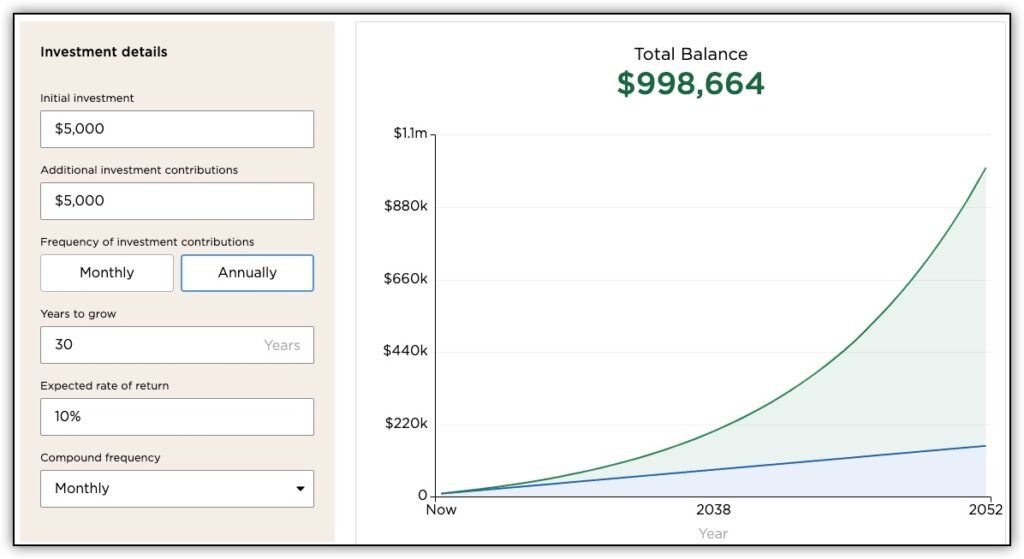
That’s all well and good, but how long is that million dollars going to last? If you retire at 55, you could be alive for another 40 years. If you were holding cash, drawing just $25,000 per year would wipe you out completely after 40 years. Even holding investments and following the 4% rule would only give you about $40,000 per year ($3,333 per month), so you’d better have your house paid off in addition to have $1,000,000 invested in the stock market… PLUS your bitcoin.
Then you’ve got to consider the tax implications of selling. Of course, to avoid a catastrophic situation you’d need to remain invested in the market and use the 4% rule (withdraw just 4% per year to avoid depleting your account).
All of that is to say if you own one bitcoin and a bitcoin is worth a million dollars by the time you retire, it probably isn’t going to solve all your money problems and give you a carefree lifestyle.
Would 2 million dollar bitcoin be enough? 3 million?
I like the framework from @BitPaine below. Not because I think he’s 100% correct, but I like the direction he’s thinking. The concept he riffs on is the idea of looking at how much bitcoin is being issued by the bitcoin network, per day. His guess is that bitcoin will be worth about $1.8 million by 2035, and you’ll need about 5-10 bitcoin to retire by 2035.
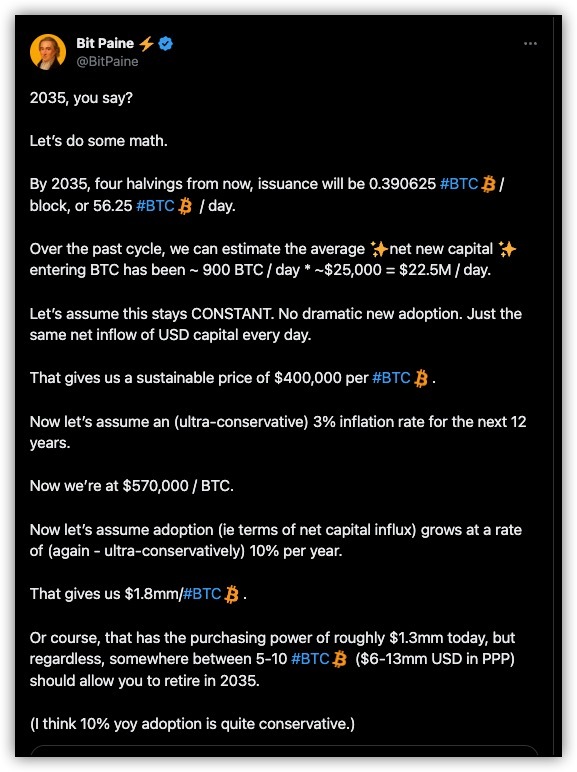
My own calculation isn’t too far off. I copied some of this methods, with my own spin based on daily mined bitcoin and how much of the daily issued bitcoin you need to own.
As of 2023, there are 900 new bitcoin issued per day. To retire comfortably today, assuming your house is paid off, and to keep your money in cash (no investing), you’d need about 3-5 million dollars.
5 million dollars is currently 192 bitcoin, or 20% of the supply of daily mined bitcoin.
In ten years the daily mined bitcoin supply will be 56 bitcoin per day. 20% of ₿56 is ₿11. So you’ll need 11 bitcoin to retire in 2035.
In twenty years (2045), the daily mined bitcoin will be 14 bitcoin. 20% of ₿14 is ₿2.8. You’ll need 2.8 bitcoin to retire in 2045.
Of course this is some insane speculation with tons of assumptions, but it’s just an exercise to get your mind thinking. Do you think you can stack and hold 2-3 bitcoin in the next twenty years?
What does retirement look like for you, and how much bitcoin do you think you need?










Leave a Reply